
- Sparc Technologies completes first commercial delivery of ecosparc® graphene additive to Tier 1 coatings customer

Sparc Technologies has completed the first commercial delivery of its ecosparc® graphene additive to a Tier 1 coatings customer, fulfilling a 160kg order from the company's production facility in Adelaide, South Australia, for use in a high-performance protective coating.The delivery follows the launch of two ecosparc®-enhanced coatings products since May 2026, including AkzoNobel's commercial release of ecosparc-enhanced Interzone 954, and represents the first widely used protective coating product to incorporate Sparc's graphene additive.
- Faint far-infrared light drives insulator-to-metal transition in magic-angle graphene
Researchers at the National University of Singapore, the Center for Neurophysics and Neuromorphic Technologies (Moscow), Queen's University (Kingston), HSE University (Moscow), the National Institute for Materials Science (Tsukuba) and the University of Manchester, have shown that magic-angle twisted bilayer graphene (MATBG) can be switched from an insulating to a metallic state by exposure to very weak far-infrared (FIR) radiation, opening a path toward ultrasensitive detectors for one of the least-exploited bands of the electromagnetic spectrum.MATBG is formed by stacking two graphene sheets with a relative twist of about one degree. At this "magic" angle, the electronic bands narrow dramatically, strengthening interactions between electrons. Under the right gate voltage, these interactions produce a correlated insulator - a fragile collective electronic state in which conduction is strongly suppressed, distinct from an ordinary band insulator.
- Gate-tunable spin bands in graphene point toward low-voltage spin transistors
Researchers at the National University of Singapore (NUS), led by Assistant Professor Ahmet Avsar of the university's Centre for Advanced 2D Materials, have combined a record-fidelity graphene spin-transport platform with magnetic-proximity band engineering to move graphene closer to practical spin-logic and spin-memory devices, across two complementary studies. The work targets one of graphene spintronics' core limitations: interfacial disorder at the electrical contacts that inject and detect spin, which has historically scrambled spin information before it can be read out electrically.The first study rebuilt the graphene spin-device fabrication process around an inert-glovebox van der Waals assembly, laminating and cleaning the stack to produce atomically flat hexagonal boron nitride (h-BN) tunnel barriers rather than the oxide barriers more commonly used in graphene spin valves. That interface quality translated directly into device performance: nonlocal spin signals reached up to 1.6 kΩ at 2.5 K, spin polarization approached 90% (89% in the lead device), spin lifetime measured about 2.04 nanoseconds with a spin diffusion length of about 4.74 μm, and gate-tunable magnetoresistance exceeded 80%. Critically for eventual device use, the effect persisted at room temperature, where the same device retained a nonlocal spin resistance of about 160 Ω and roughly 42% spin polarization.
- Scientists discover two superconducting states hiding as one
Scientists have uncovered hidden complexity inside two ultrathin superconductors that seemed much simpler than they really are. Niobium diselenide and tantalum disulfide appeared to have a single superconducting state, but highly sensitive measurements revealed that each actually contains two strongly interacting states working so closely together that they masquerade as one.
- Graphene improves ZnO:Sm nanocomposite dielectric conductivity by up to seven orders of magnitude

Researchers at Romania's National Institute for Research and Development in Microtechnologies (IMT-Bucharest), working with the "Petru Poni" Institute of Macromolecular Chemistry in Iasi, the Horia Hulubei National R&D Institute for Physics and Nuclear Engineering's Extreme Light Infrastructure-Nuclear Physics facility, the National University of Science and Technology POLITEHNICA Bucharest, and Hellenic Mediterranean University in Greece, have shown that adding small amounts of graphene to samarium-doped zinc oxide (ZnO:Sm) nanocomposites raises dielectric conductivity by up to seven orders of magnitude, from around 10⁻⁹ S/cm for pure ZnO to 10⁻³–10⁻² S/cm at the highest graphene loadings tested. ZnO is a widely used wide-bandgap semiconductor (~3.37 eV) valued for its thermal and chemical stability, low cost, and non-toxicity, with applications spanning optoelectronics, energy, environmental remediation, antibacterial textiles, and pharmaceuticals. Its practical use in electronic, energy, and thermoelectric applications, though, is limited by relatively low electrical conductivity stemming from a low charge-carrier concentration. Researchers have previously addressed this through doping, engineered oxygen vacancies, nanostructuring, and surface functionalization. Doping with trivalent rare-earth ions such as Sm3+ improves conductivity by inducing structural defects and oxygen vacancies that modulate carrier concentration, while separately, incorporating graphitic carbon into ZnO matrices has been shown to improve charge transport and suppress electron-hole recombination, given graphene's high carrier mobility, large surface area, and strong conductivity. According to the authors, combining rare-earth doping with graphene in a single ZnO system has been little studied, and no prior work had looked specifically at electrospun Sm-doped ZnO modified with low graphene loadings.
- New graphene oxide-based catalyst boosts zinc-air battery performance

Researchers at CICATA-Legaria, the National Laboratory for Energy Conversion and Storage at Mexico's Instituto Politécnico Nacional (IPN) in Mexico City, have developed a composite of pyridine-coordinated transition-metal nitroprussides and reduced graphene oxide (rGO) as a bifunctional pre-electrocatalyst for zinc-air batteries (ZABs). Testing cobalt, nickel, and copper versions of the material, the team found that each metal favors a different half of the battery's oxygen chemistry, with the cobalt variant striking the best overall balance. Rechargeable zinc-air batteries are attractive for their high theoretical energy density, low cost, and inherent safety, but their air cathode has to drive both the oxygen reduction reaction (ORR) during discharge and the oxygen evolution reaction (OER) during charging, reactions with sluggish kinetics that typically require different types of catalysts. The field's benchmark catalysts, platinum for ORR and iridium or ruthenium oxides for OER, are scarce and expensive, pushing research toward cheaper first-row transition metals such as cobalt, nickel, and copper. Nitroprussides, a family of cyanometallate coordination polymers with the general formula T[Fe(CN)5NO], offered the team a synthetically simple, structurally tunable starting point for that search.
- Some signs of quantum gravity may be an illusion
Quantum mechanics and Einstein’s theory of gravity explain almost everything we see in nature, yet physicists still do not know how to unite them. A new theoretical framework suggests that some experiments that appear to show gravity behaving quantum mechanically may have a much more ordinary explanation. Researchers found that scenarios involving a supposed “superposition of gravity” can sometimes be described equally well as quantum particles moving through classical spacetime.
- Biodegradable graphene-oxide platform senses neurotransmitters, modulates brain astrocyte signaling

Researchers at Italy's National Research Council (CNR) - specifically its Institute for Organic Synthesis and Photoreactivity (Cnr-Isof) and Institute of Nanostructured Materials (Cnr-Ismn) - working with Ca' Foscari University of Venice, the University of Ferrara, and the University of Bologna, have developed a graphene-based bioelectronic platform that combines sustainable materials, biochemical sensing, and neural stimulation in a single biodegradable device, aimed at both monitoring and modulating activity in brain tissue. The platform is built from poly(lactic acid) (PLA) and graphene oxide, processed through a green, water-based manufacturing route and turned into conductive electrodes through laser functionalization rather than more environmentally costly fabrication methods. The approach is meant to address the growing footprint of implantable and wearable medical electronics by keeping the device fully biodegradable and biocompatible while still delivering the electrical performance needed for neural interfacing.
- Premier Graphene, HGI deliver second batch of tactical belts under Mexico's SEDENA contract
Premier Graphene (OTC: BIEI) and joint venture partner HGI Industrial Technologies have delivered a second batch of tactical belts to the Dirección General de Fábrica de Vestuario y Equipo (FAVE), a division of Mexico's Secretaría de la Defensa Nacional (SEDENA), keeping production on schedule under the companies' defense supply contract.The delivery is part of a 1,600-unit order for SEDENA, and follows the completion and inspection-acceptance of an initial batch of 200 belts. Premier Graphene and HGI previously confirmed initial deliveries under the contract in May without disclosing batch sizes or the total order volume at the time; this release is the first to put concrete numbers on the program's scale. The companies said the remaining balance of the order will follow according to the agreed production schedule.
- Scientists switch on a strange new form of magnetism in an ultrathin material
Scientists have found a surprising way to potentially switch on an unusual form of magnetism in ruthenium dioxide, a material that normally appears nonmagnetic. When the material was made into an ultrathin film only a few atomic layers thick and placed under strain, its electrons developed patterns consistent with altermagnetism, a recently proposed magnetic state with promising uses in advanced electronics.
- Newspaper cellulose enables tap-water processing of e-waste graphite into graphene

Researchers at Dublin City University (DCU), led by materials scientist Conor Boland, have shown that graphene can be produced from electronic-waste graphite using little more than a kitchen blender, waste newspaper and ordinary tap water, extending the group's earlier household-graphene work to waste-derived starting materials as well as waste-derived processing. The starting point is the graphite heat spreaders found inside phones, laptops and other devices, which draw heat away from components and typically become electronic waste once a device reaches end of life. Around 62 million tonnes of e-waste were generated globally in 2022, of which only 22.3% was documented as properly collected and recycled, and the researchers note that graphite tends to get overlooked next to the metals that dominate e-waste recovery efforts. Chemically, that discarded graphite is no different from the graphite used to make graphene, which consists of single-atom-thick carbon sheets stacked like a deck of cards.
- Argo Graphene amends $1 million financing, advances STREAM graphene commercialization
Argo Graphene Solutions Corp. (CSE: ARGO), developer of the STREAM™ graphene production platform, has amended the terms of the non-brokered private placement it announced earlier this month. Under the revised terms, Argo now proposes to issue up to 1,250,000 units at CA$0.80 per unit (about US$0.58), down from the original CA$1.00 per unit, for aggregate gross proceeds of up to CA$1,000,000 (about US$722,600), with an over-allotment option for a further 250,000 units that could bring the total to CA$1,200,000 (about US$867,200). Each unit consists of one common share and one warrant, with each warrant exercisable into an additional share at $1.00 for one year. The offering remains subject to a four-month-and-one-day statutory hold and approval from the Canadian Securities Exchange.Proceeds are earmarked for securing and developing a facility in the Chicago area, advancing STREAM™ technology and related intellectual property, establishing a graphene refinery, and general working capital. STREAM™, developed at Grapherry, Inc. under the leadership of Dr. Vikas Berry and exclusively licensed to Argo with a contractual path to full ownership, produces both STREAM-G™ graphene and STREAM-O™ graphene oxide from carbon-rich feedstocks.
- Atomic catalyst unlocks the hidden value of plant waste
Scientists have created a highly efficient catalyst that breaks down stubborn lignin from plant waste into useful chemicals under relatively mild conditions. By revealing exactly how the catalyst works at the atomic level, the discovery could help turn forestry and agricultural waste into renewable building blocks for fuels, plastics, and other materials.
- GMG launches G FLUID, a graphene-based coolant additive for data center cooling systems

Graphene Manufacturing Group (GMG) has launched G FLUID™, a patent-pending graphene water-based additive designed to improve heat transfer and curb microbial growth in data center and industrial cooling circuits. The product is sold as a 1-liter concentrate dosed at a 1:100 ratio into existing coolant loops, and targets the cooling water treatment chemicals market. In preliminary internal testing, dosing demineralized water with G FLUID™ at 1%, providing 0.01% graphene by weight in the final solution, increased heat transfer by approximately 20%. Independent third-party laboratory testing to the EN 1276 standard found the same dosing reduced microbial growth by up to 87%, a factor GMG says matters for operators managing corrosion, fouling and maintenance costs in chiller systems.
- GMG Launches New Graphene Water Coolant Additive for Data Centres: G FLUID™
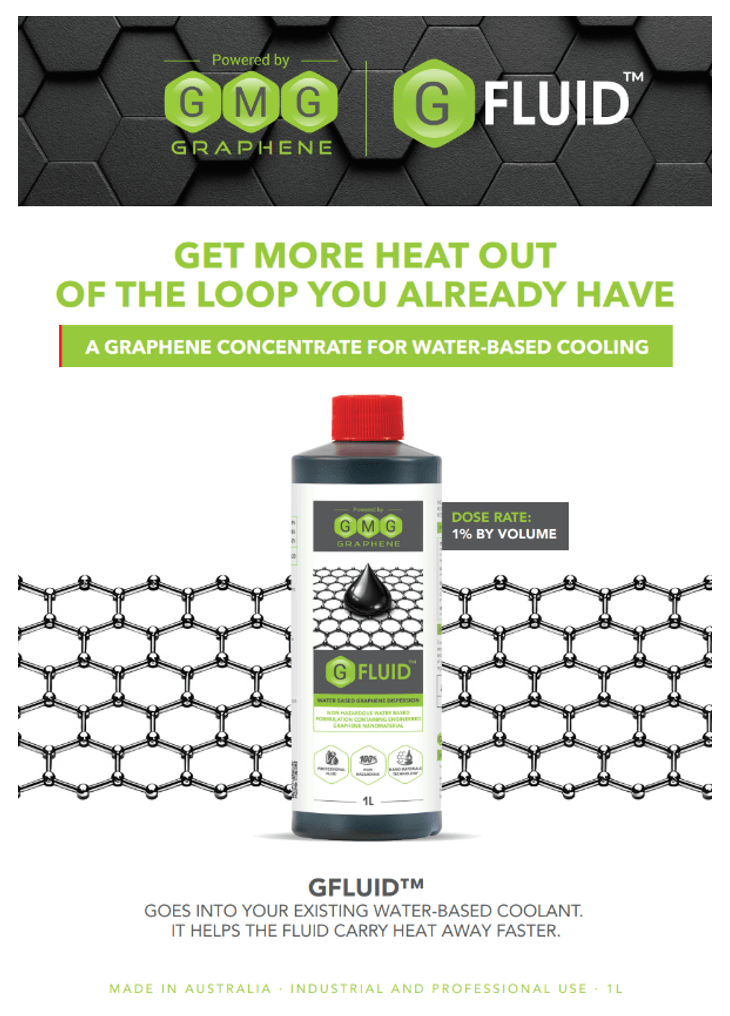
Graphene Manufacturing Group Ltd. (TSX-V: GMG) (OTCQX: GMGMF) (“GMG” or the “Company”) is pleased to announce the launch of patent pending G FLUIDTM for use as a graphene water-based additive for data centre and industrial cooling circuits to increase heat transfer and reduce microbial and bacterial growth. The cooling water treatment chemicals market is valued