
- Scientists discover two superconducting states hiding as one

Scientists have uncovered hidden complexity inside two ultrathin superconductors that seemed much simpler than they really are. Niobium diselenide and tantalum disulfide appeared to have a single superconducting state, but highly sensitive measurements revealed that each actually contains two strongly interacting states working so closely together that they masquerade as one.
- Some signs of quantum gravity may be an illusion
Quantum mechanics and Einstein’s theory of gravity explain almost everything we see in nature, yet physicists still do not know how to unite them. A new theoretical framework suggests that some experiments that appear to show gravity behaving quantum mechanically may have a much more ordinary explanation. Researchers found that scenarios involving a supposed “superposition of gravity” can sometimes be described equally well as quantum particles moving through classical spacetime.
- Scientists switch on a strange new form of magnetism in an ultrathin material
Scientists have found a surprising way to potentially switch on an unusual form of magnetism in ruthenium dioxide, a material that normally appears nonmagnetic. When the material was made into an ultrathin film only a few atomic layers thick and placed under strain, its electrons developed patterns consistent with altermagnetism, a recently proposed magnetic state with promising uses in advanced electronics.
- Atomic catalyst unlocks the hidden value of plant waste
Scientists have created a highly efficient catalyst that breaks down stubborn lignin from plant waste into useful chemicals under relatively mild conditions. By revealing exactly how the catalyst works at the atomic level, the discovery could help turn forestry and agricultural waste into renewable building blocks for fuels, plastics, and other materials.
- GMG Launches New Graphene Water Coolant Additive for Data Centres: G FLUID™
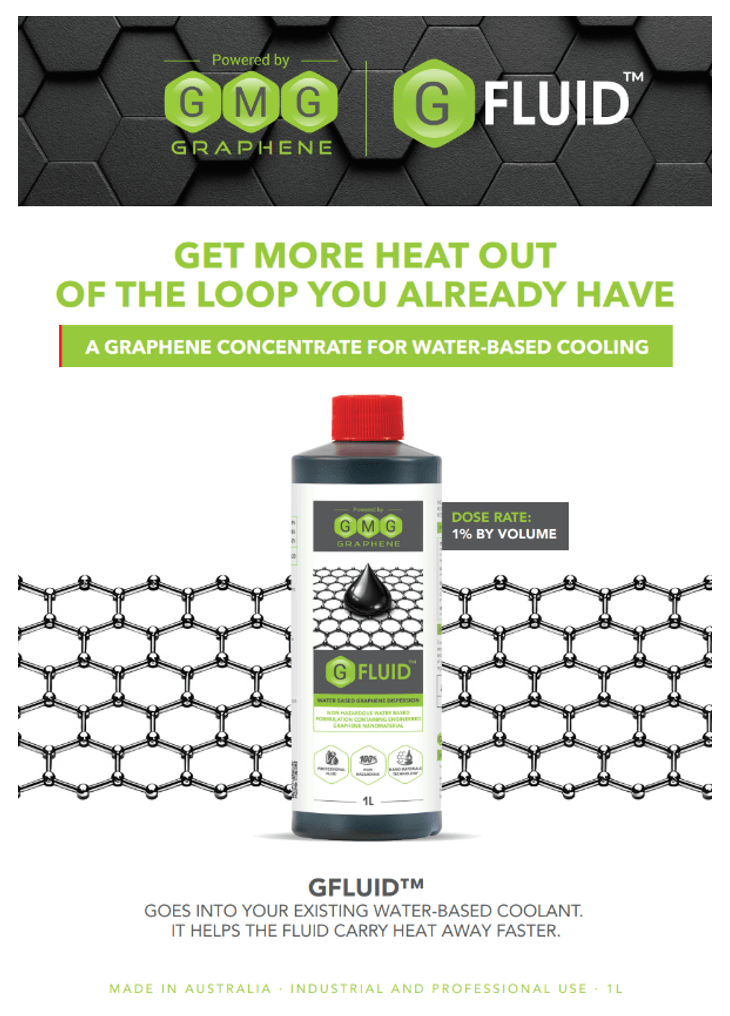
Graphene Manufacturing Group Ltd. (TSX-V: GMG) (OTCQX: GMGMF) (“GMG” or the “Company”) is pleased to announce the launch of patent pending G FLUIDTM for use as a graphene water-based additive for data centre and industrial cooling circuits to increase heat transfer and reduce microbial and bacterial growth. The cooling water treatment chemicals market is valued
- Physicists create a tiny “Big Bang” with surprisingly small atomic nuclei
Researchers at CERN have created microscopic versions of the early Universe by colliding surprisingly small atomic nuclei at nearly the speed of light. The collisions produced quark-gluon plasma, the ultra-hot matter believed to have filled the cosmos shortly after the Big Bang. Even more intriguingly, the particles left behind reveal the shape of the nuclei that created them, offering a new way to probe both nuclear physics and the Universe’s earliest moments.
- This frozen fiber makes light and sound interact 1,000x more strongly
Freezing the liquid core of an optical fiber produced an extreme environment where light and sound interact more than 1,000 times more strongly than in ordinary fibers. Researchers used the effect to create optoacoustic memory, potentially paving the way for lower-energy photonic computers and advanced quantum technologies.
- A strange new quantum droplet can hold itself together
Two very different types of quantum particles may be able to form stable droplets that hold themselves together, challenging decades of conventional thinking. The prediction could soon be tested experimentally and may reveal an unexpectedly rich world of new quantum phases.
- Scientists crushed diamond beyond Neptune-like pressures—and solved a 20-year mystery
Extreme experiments have revealed how diamond behaves at crushing pressures beyond those inside Neptune and Uranus, resolving a decades-old conflict between theory and observation. The results could help scientists boost fusion energy output while revealing more about the exotic diamond rain hidden inside ice giant planets.
- MIT physicists discover electrons rebuilding like ice inside a quantum material
MIT physicists found that two electronic phases inside the same quantum material emerge through surprisingly different mechanisms—one smoothly and the other in expanding pockets resembling growing ice crystals. The discovery could help explain how exotic properties such as superconductivity and magnetism develop and coexist.
- Tiny quantum engines reveal useful energy hiding in “waste heat”
A tiny machine made from just an atom and particles of light may sound impossibly simple, but it raises a surprisingly difficult question: what counts as heat, and what energy can still do useful work? University of Basel researchers have developed a theoretical framework that brings quantum physics and thermodynamics into better agreement for these microscopic “light engines.”
- Scientists may have finally proved that “empty” space isn’t really empty
A magnetar’s colossal magnetic field may have revealed a quantum effect predicted by Werner Heisenberg nearly 90 years ago, in which seemingly empty space alters the behavior of light. If confirmed, the discovery could offer the first direct evidence of vacuum birefringence and open a new window into the strange physics of the quantum vacuum.
- Caltech breakthrough brings fiber-optic performance to silicon chips
Caltech scientists have created ultra-low-loss optical pathways on silicon chips that approach the efficiency of fiber optics and dramatically outperform existing technology at visible wavelengths. The breakthrough could unlock more powerful lasers, miniature atomic sensors and clocks, quantum systems, and more energy-efficient data centers.
- Tiny graphene wrinkles create surprisingly powerful electrical effects
Scientists have discovered that tiny, sharply curved wrinkles in graphene can dramatically alter its electrical behavior, creating surprisingly strong charge separation. The finding suggests future electronics could be tuned by reshaping materials at the atomic scale instead of changing what they’re made of.
- World’s first superconducting quantum heat engine could help unlock massive quantum computers
A tiny superconducting engine has successfully converted heat near absolute zero into useful work, demonstrating the first cyclic quantum heat engine of its kind. Future versions could operate autonomously inside quantum computers, potentially eliminating huge numbers of costly, noise-producing microwave cables.